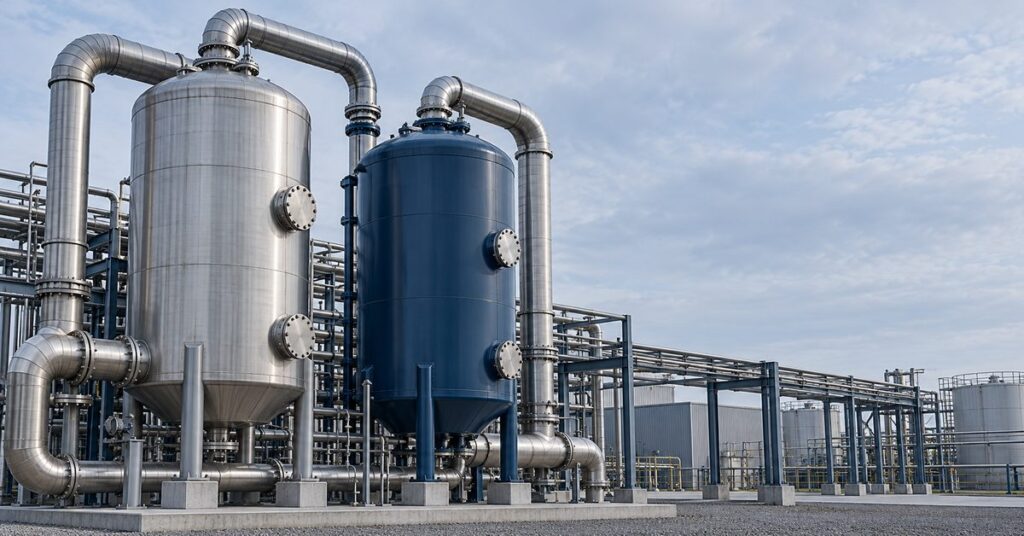
Vapour recovery by activated carbon is the removal of solvent vapours and odorous gases from a waste gas stream by passing it through a bed of activated carbon, which holds the contaminant inside its pore structure. A conventional single-pass adsorber is sized on three numbers: a face velocity of 0.15–0.3 m/s, an empty-bed contact time of at least 2–4 seconds, and a pressure drop of roughly 1.5–2 inches water column per foot of bed depth. The carbon grade is then chosen against the stream itself — standard granular carbon below 50% relative humidity, KOH-impregnated carbon where H2S or other acid gases are present, acid-impregnated carbon for ammonia and amines, and KI-impregnated carbon for mercury vapour. Working capacity is typically 5–20% of the carbon’s own weight, which is what sets bed life.
emission limit before it leaves the site. Illustration.
How does an activated carbon adsorber work?
A gas-phase activated carbon filter is a vessel holding a bed of carbon through which the waste gas passes once. Solvent and odour molecules are held inside the carbon’s pore structure by physical adsorption; some gases are held chemically, by an impregnant added to the carbon for that purpose. Nothing is destroyed. The contaminant is transferred from the gas to the carbon, and when the carbon is full, it passes straight through.
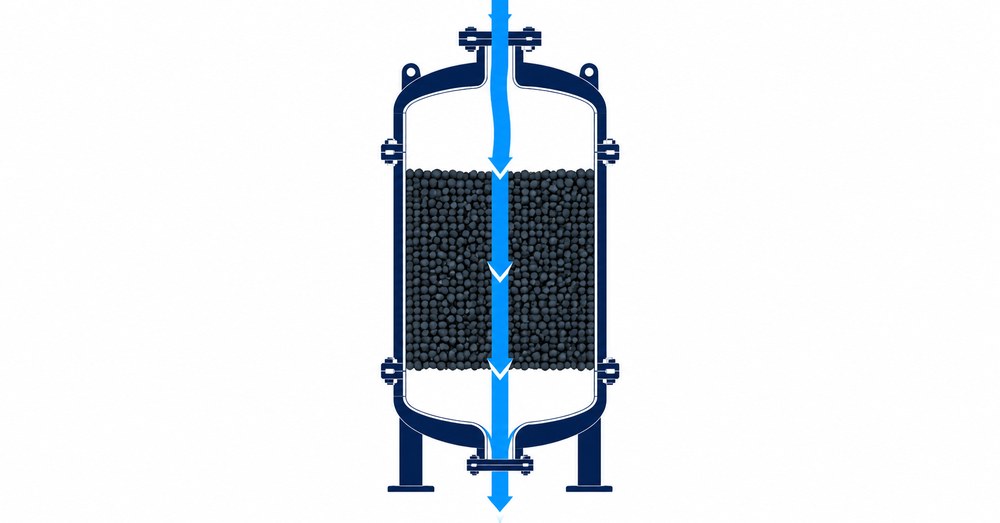
That single sentence governs every design decision that follows. Capacity is finite, so the questions worth asking are: how much contaminant per hour, how long must the bed last, and will this particular carbon hold this particular molecule at the humidity and temperature of this stream?
How is a VOC adsorber sized? Face velocity, EBCT and pressure drop
A conventional single-pass adsorber is a vertical cylindrical vessel with inlet and outlet plenums, a flow distributor, a perforated support grid holding the bed, differential-pressure tappings above and below the bed, sample ports, and top-fill and bottom-drain nozzles for media change-out. Shell and heads in mild steel suit standard duty; stainless 304 or 316 is normal for wet or acid-gas service, with stainless or FRP internals that resist H2Sand moisture.
The numbers below are the industry-standard starting ranges. They are not a design; they are the envelope a sound design sits inside.
| Parameter | Standard range | Why it matters |
|---|---|---|
| Superficial (face) velocity | 0.15–0.3 m/s (30–60 ft/min) | Too fast and the gas short-circuits the bed; too slow and the vessel is needlessly large |
| Empty-bed contact time (EBCT) | 2–4 seconds minimum, more for difficult compounds | The real measure of whether a molecule has time to reach an adsorption site |
| Bed pressure drop | ≈1.5–2 in WC per foot of bed depth | Sets blower duty and limits how deep a bed you can afford |
| Total system static pressure | ≈15–20 in WC including pre-filter and ducting | The budget the whole train must fit within |
| Standard module | ≈1 m diameter × ≈2 m bed depth ≈ 2 m³ fill, handling ≈250–800 CFM | A practical building block for most industrial flows |
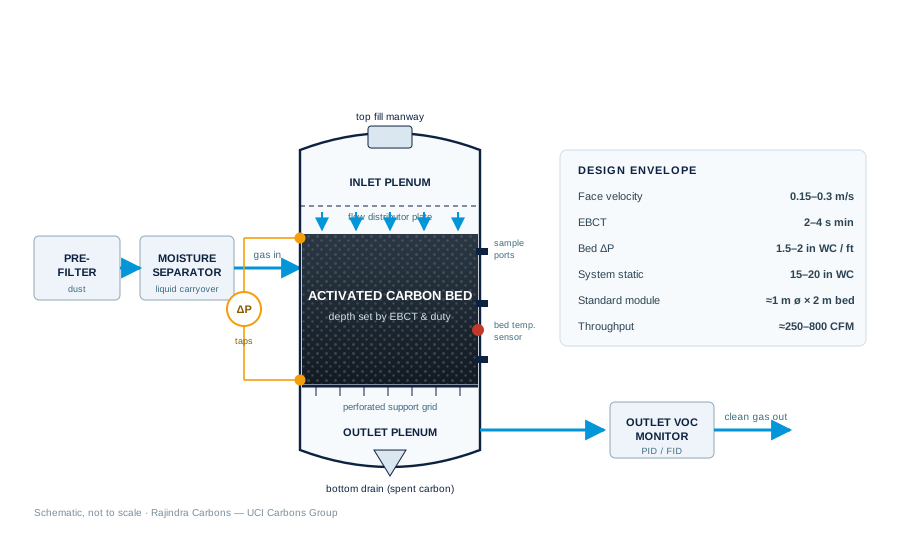
For larger flows, add modules in parallel rather than oversizing one vessel. Parallel modules keep face velocity and contact time where you designed them, and let you take one unit out of service without stopping the process.
Instrumentation worth insisting on. A differential-pressure gauge or transmitter to track fouling and channelling; bed temperature sensors where VOC loading is high; an outlet PID or FID monitor for breakthrough detection and compliance evidence; a moisture separator and pre-filter ahead of the bed; explosion relief and a flame arrestor wherever the vapours are flammable; and sample ports at top, middle and bottom so bed condition can be checked without opening the vessel.
Lead-lag or duty/standby: one bed or two?
A single vessel is only appropriate where a short outage is acceptable. For continuous-compliance duty, run two or more: lead-lag in series, where the lead bed is changed at saturation while the lag bed still protects the outlet, or duty/standby in parallel, where one unit can be isolated and serviced while the other carries the flow.
Which variables change the design?
Most real designs are driven by two or three of the following dominating the rest — a low flow but very humid stream, or a modest concentration of a light solvent that standard carbon barely holds.
| Variable | Effect on the design | Typical response |
|---|---|---|
| Flow rate | Sets the cross-sectional area needed at design velocity | More parallel modules, not one oversized vessel |
| VOC concentration / mass loading | Higher loading saturates the carbon faster | Deeper bed, more frequent change-out, or lead-lag |
| Molecular weight and volatility | Light, low-boiling compounds are weakly held | Longer EBCT and a higher-activity, higher-BET carbon |
| Gas temperature | Higher temperature cuts adsorption capacity | Cooling stage upstream |
| Relative humidity | Water competes for sites above roughly 50% RH | Pre-cooling or coalescing, moisture separator, or a larger bed |
| Particulate loading | Fouls and channels the bed, raising ΔP over time | A pre-filter stage ahead of the carbon, always |
| Acid gases (H2S, SO2, HCl, mercaptans) | Barely held by plain carbon | Alkaline (KOH) impregnated carbon |
| Basic gases (ammonia, amines) | Held by neither plain nor KOH carbon | Acid-impregnated carbon, or a dedicated polishing stage |
| Flammability | Self-heating and fire risk rise with solvent loading | Bed temperature monitoring, explosion relief, conservative depth |
| Available pressure drop | Caps bed depth and number of stages | Lower design velocity and a wider vessel instead of a deeper bed |
| Carbon consumption | High volumes change the economics | A regenerative two-bed system becomes worth studying above roughly 3,000–5,000 CFM |
Which activated carbon grade should you specify?
Carbon grade is not a single decision. It is the intersection of three questions: how wet is the stream, is the chemistry acidic or basic, and what class of molecule are we trying to hold?
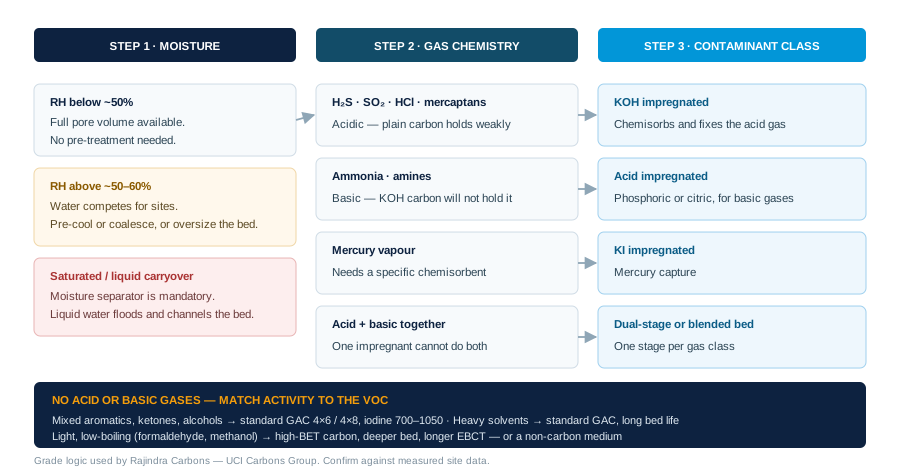
Does humidity affect activated carbon adsorption?
- Below ~50% RH: standard vapour-phase granular carbon. The full pore volume is available for the VOC.
- Above ~50–60% RH: pre-cool or coalesce upstream, or oversize the bed. Water vapour takes up sites and working capacity falls away quickly.
- Saturated or condensing, with liquid carryover: a moisture separator ahead of the bed is not optional. Liquid water floods the pores and can channel the bed outright.
Which carbon removes H2S, ammonia or mercury?
| Stream contains | Carbon to specify | Why |
|---|---|---|
| H2S, SO2, HCl, mercaptans | KOH (alkaline) impregnated | Chemisorbs and fixes the acid gas; plain carbon only weakly physisorbs it |
| Ammonia, amines | Acid-impregnated (phosphoric or citric) | Neutralises a basic gas that KOH carbon cannot hold |
| Both acid and basic gases | Dual-stage bed, or a custom blend | One impregnant is optimised for one gas class, never both |
| Mercury vapour | KI (iodide) impregnated | A specific chemisorption mechanism for mercury |
| Acidic condensate downstream | Low-ash, acid-washed grade | Minimises mineral and ash leaching into the condensate |
Which carbon suits which VOC type?
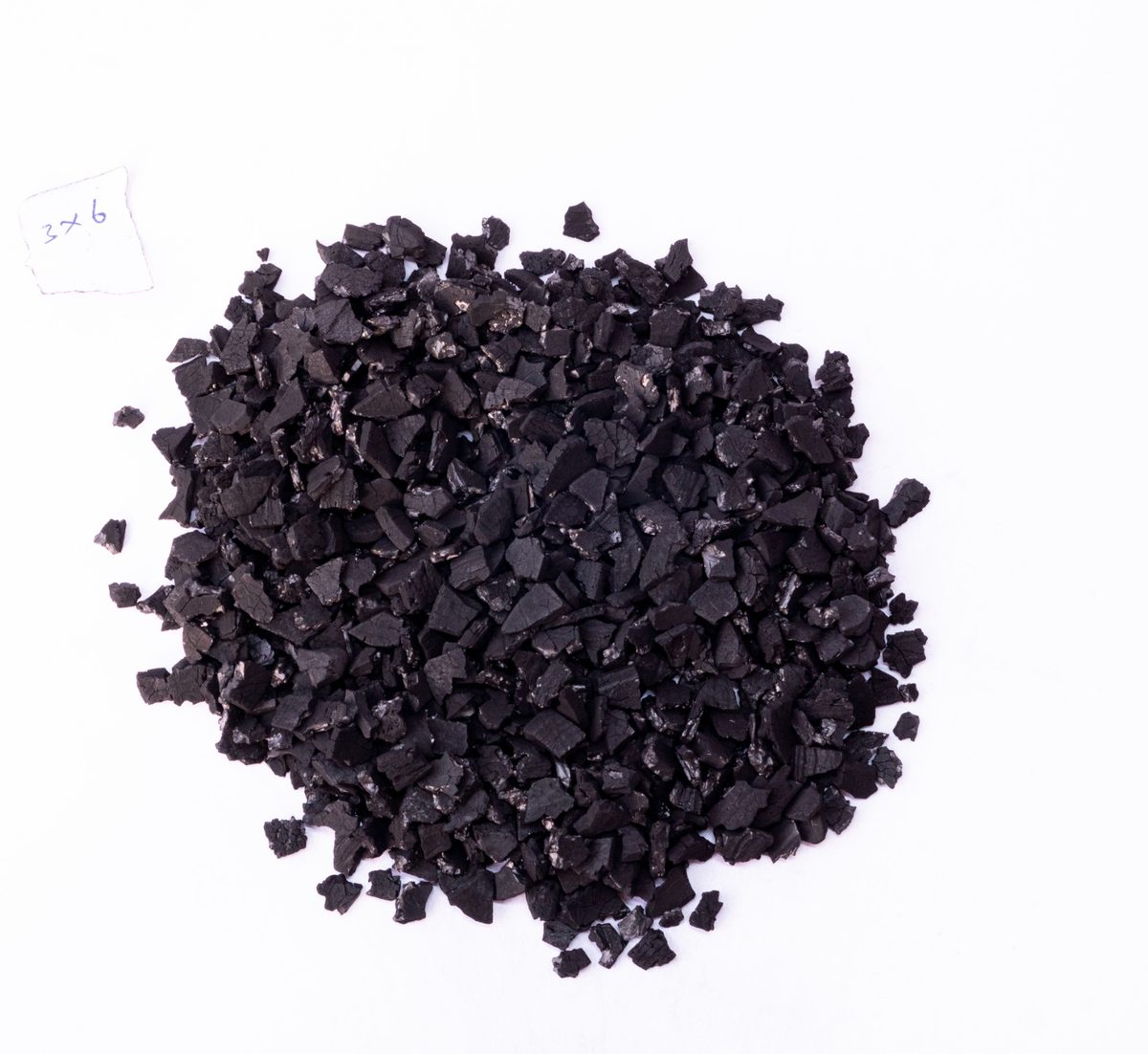
- Mixed aromatics, ketones and alcohols of moderate molecular weight: standard vapour-phase GAC, 4×6 or 4×8 mesh, iodine 700–1050 mg/g. Good general affinity and proven in service.
- Light, low-boiling compounds such as formaldehyde or methanol: a higher-BET carbon with a deeper bed and longer EBCT — or, honestly, a non-carbon medium. These break through fast on standard grades.
- Heavy solvents and high molecular weight aromatics: standard GAC, with long bed life expected. These are strongly retained.
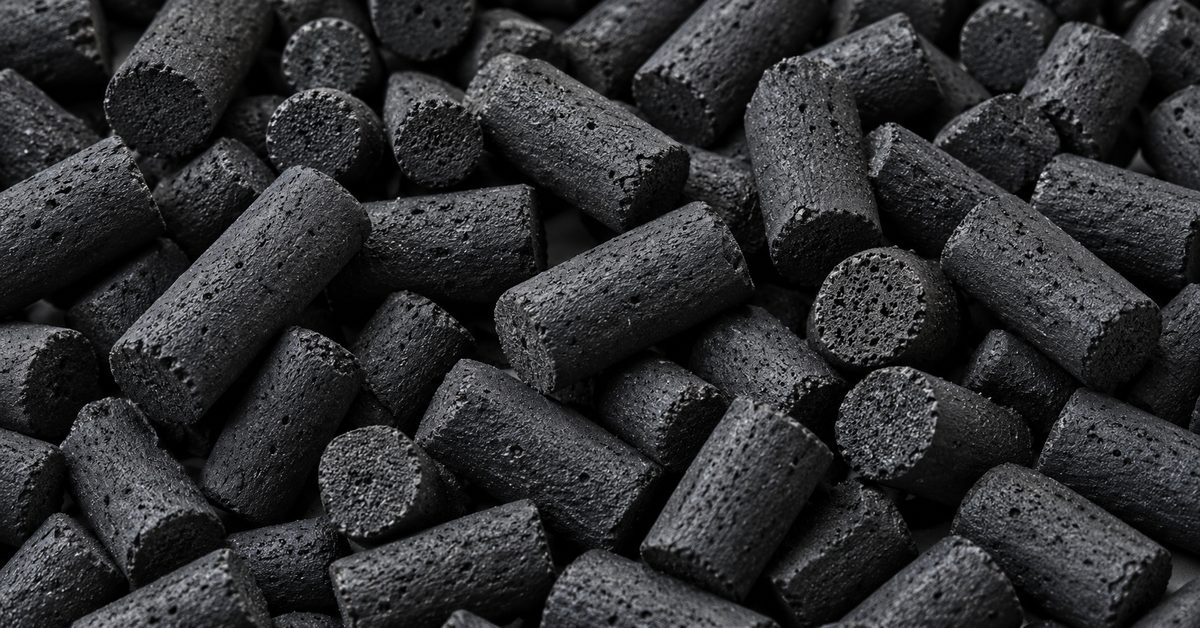
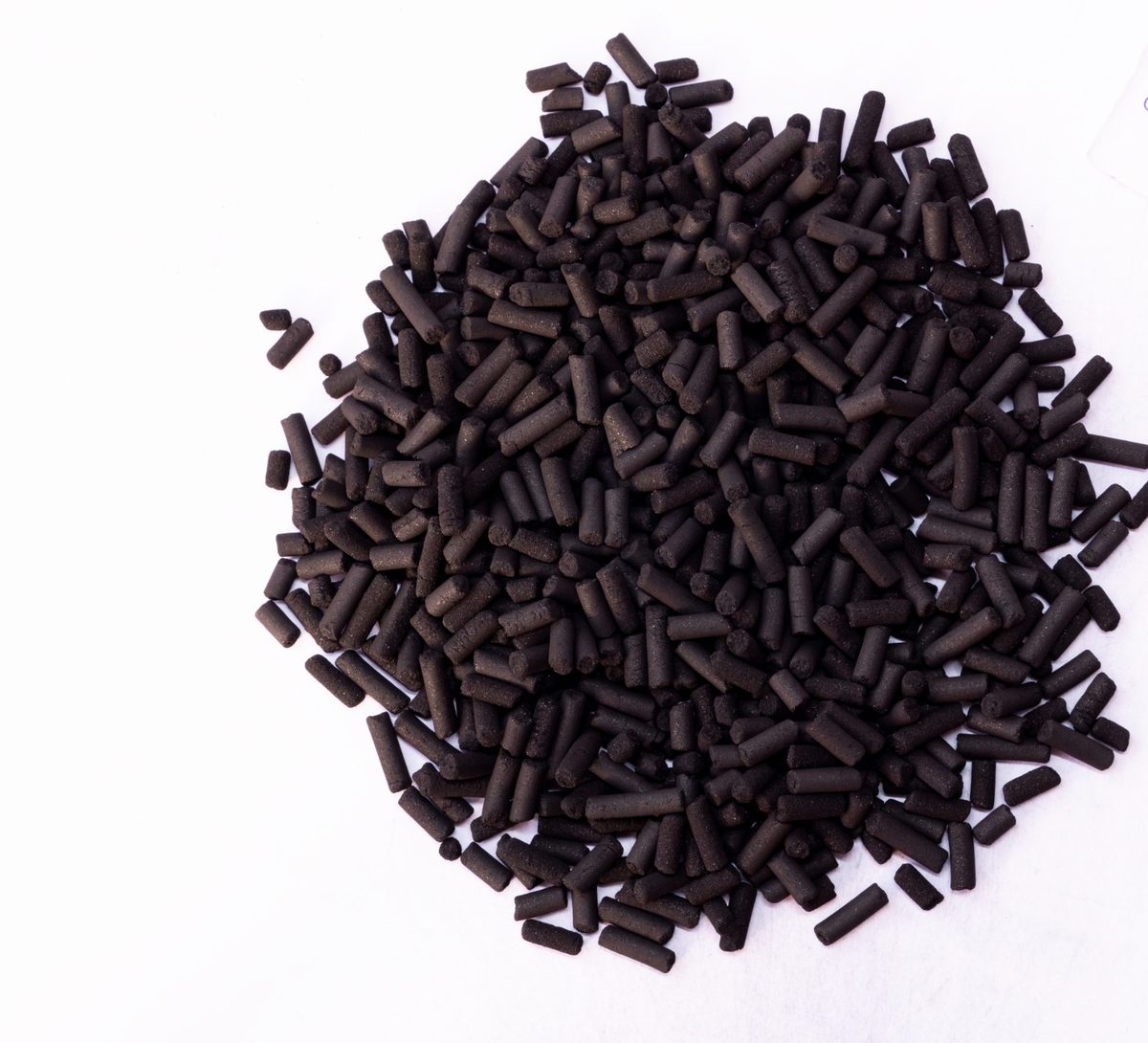
- Pellets versus granules: extruded cylindrical pellets, typically 3, 4 or 5 mm, give a lower and more even pressure drop in deep fixed beds and radial-flow filters. Granular grades suit shallower beds and lower-flow work.
How long does activated carbon last in a VOC filter?
Working capacity for a well-adsorbed VOC is typically 5–20% of the carbon’s own weight — less under high humidity, and less again with weakly held light compounds. Life is simply that capacity divided by the mass loading, which is concentration × flow × operating hours. Field ranges look like this.
| Duty | Typical life | What drives it |
|---|---|---|
| Light or intermittent odour control | 12–24 months | Low mass loading, occasional operation |
| Moderate continuous industrial VOC | 3–12 months | Steady loading, mixed solvent duty |
| High-concentration continuous solvent | 4 weeks – 3 months | Fast saturation; needs lead-lag or frequent change-out |
| Impregnated grades (H2S, mercury) | Site-specific | Governed by chemisorption capacity, not physical loading; monitor the outlet gas |
Breakthrough is detected properly by an outlet PID, FID or electrochemical sensor. A ΔP trend tells you about channelling and fouling, not about saturation — a bed can be entirely spent at an unchanged pressure drop. Where no online monitor exists, use scheduled lab sampling, with a calculated change-out date as the fallback.
Request a technical data sheet →
For change-out: isolate and ventilate the vessel, wetting the bed first if there is any self-heating risk; drain the spent carbon from the bottom nozzle by gravity or vacuum truck; inspect the distributor and support grid before refilling; refill through the top manway to the specified height and weight; and treat the vessel as a confined space throughout, because carbon depletes oxygen.
Reactivation or disposal. Virgin granular carbon can often go for off-site thermal reactivation where the volumes justify the logistics. Impregnated grades used for chemisorption — KOH for H2S,acid-impregnated for ammonia, KI for mercury — are generally single-use and are disposed of under the applicable waste rules.
What data does a supplier need before quoting?
Any supplier can propose a vessel. A firm carbon grade, fill quantity and bed depth need site data. These are the questions we ask, and they are a fair test of whether a proposal in front of you was engineered or guessed.
- What process produces the gas stream?
- Flow rate in CFM or Nm³/hr, and is the duty continuous or intermittent?
- Operating hours per day and days per year.
- Gas temperature, normal and maximum.
- Relative humidity or moisture content, and is there any condensation?
- The VOC components and their concentrations, with a lab report if one exists.
- Presence and concentration of H2S, SO2, HCl, mercaptans, ammonia or amines.
- Particulate or dust loading.
- Operating pressure and the available pressure-drop budget.
- The outlet emission limit or regulatory standard to be met.
- Duct size, material and connection point.
- Footprint available for the skid.
- Is the area classified as flammable or explosive?
- Utilities available — power for the blower, steam or nitrogen if needed.
- Single-pass replaceable media, or interest in a regenerative system?
- Any existing system, and how it has performed.
Even partial answers are enough to move from general guidance to a specific recommendation. The two that change the answer most often are humidity and the acid-gas question — a stream nobody mentioned was wet, or an H2Strace nobody tested for, accounts for a large share of beds that fail early.
Questions we get asked most
These are the situations engineers call us about, and the answers we give before anyone talks about price.
Our bed broke through in three weeks. What went wrong?
Almost always one of three things. The stream was wetter than the design assumed, so working capacity was a fraction of what was expected. The gas carried an acid gas nobody tested for, and plain carbon barely holds H2S. Or the mass loading was simply higher than the number used for sizing — concentration × flow × running hours is what consumes the bed, and plants rarely run at the figure on the datasheet. Measure the inlet before buying more carbon; replacing like with like just repeats the cycle.
Pressure drop is climbing but the outlet is still clean. Do we change the carbon?
No — that is a fouling signal, not a saturation signal. Rising ΔP usually means dust is blinding the top of the bed or the bed has started to channel. Saturation often arrives at an unchanged pressure drop, which is why ΔP alone is an unreliable change-out trigger. Fix the pre-filter, skim and inspect the top of the bed, and use an outlet monitor or lab sample to judge the carbon itself.
Can we regenerate the carbon instead of replacing it?
Virgin granular carbon loaded with ordinary solvents can usually go for off-site thermal reactivation once your volumes justify the transport. Impregnated grades generally cannot — KOH for H2S, acid-impregnated for ammonia, KI for mercury all work by chemical reaction, and the impregnant is consumed. Treat those as single-use. On-site steam regeneration is a different proposition and only becomes economic on continuous solvent recovery duty, typically above roughly 3,000–5,000 CFM.
Our gas is at 60 °C. Does temperature matter that much?
Yes. Adsorption capacity falls as temperature rises for most VOCs, so a hot stream costs you bed life twice over — less capacity per kilogram and often a higher moisture carry. If you cannot cool it, the bed has to grow. Cooling upstream is usually cheaper than the extra carbon over a year.
The supplier quoted an iodine number. Is that the right spec for gas phase?
Iodine number is a liquid-phase indicator. For vapour duty, the number that matters is CTC activity (ASTM D3467) together with hardness and the mesh or pellet size. Iodine is useful as a general activity check, but a gas-phase quote with no CTC figure has not been specified properly.
Can one carbon handle solvents and H2S together?
Partly, and that is the trap. KOH-impregnated carbon will hold the H2S and still physically adsorb solvent vapour, but the impregnant occupies pore volume, so VOC capacity is lower than the plain grade. Where both loads are significant, two stages — plain carbon for the solvent, impregnated for the acid gas — give longer total life than one compromise bed.
Pellets or granular?
Pellets for deep fixed beds and radial-flow filters, where their even voidage keeps pressure drop low and predictable. Granular for shallower beds, lower flows and where cost per kilogram matters more than ΔP. Both are steam activated; the difference is bed hydraulics, not adsorption chemistry.
How much carbon do we need for our flow?
As a first pass: bed volume (m³) ≈ flow (m³/s) × EBCT (s). At 0.5 m³/s, roughly 1,800 m³/hr, and a 2-second contact time, that is about 1 m³ of carbon — around 450–500 kg at typical granular density. Then check the facevelocity falls inside 0.15–0.3 m/s and the pressure drop fits your blower. That gets you to a sanity check, not adesign.
The odour came back suddenly after months of good performance.
That is the classic breakthrough curve — carbon gives near-complete removal until the mass transfer zone reaches the outlet, then performance collapses over days rather than degrading gently. It usually means nothing changed in the plant; the bed simply reached capacity. If it happened far earlier than predicted, go back to the loading calculation and the humidity.
The vendor quotes a capacity figure far above what we see. Why?
Because equilibrium capacity and working capacity are different numbers. Equilibrium capacity is what the carbon holds at saturation in a laboratory isotherm; working capacity is what you actually get between fresh fill and the outlet limit you are allowed to reach. EPA-derived design material puts typical working capacity around 10–20 lb of contaminant per 100 lb of carbon, and warns that equilibrium figures should not be used on their own to size a bed or to compare two carbons. If a quotation does not say which one it is quoting, ask.
We have a solvent mixture. Why does the lightest compound break through first?
Competitive displacement. Heavier, less volatile molecules are held more strongly and progressively push the lighter ones off the carbon, so capacity for the volatile component falls as the cycle runs. The design rule is to size the adsorption cycle on the least adsorbable component in the stream — the one that will appear at the outlet first — rather than on an average of the mixture.
We run H2S odour control. What life should we plan for?
Work from loading, not the calendar. Impregnated carbon typically holds 10–30% of its own weight as sulphur before breakthrough, so life scales inversely with inlet concentration: industry figures put roughly 6–12 months at around 10 ppm on a 100 Nm³/hr duty, falling to 1–3 months at 100 ppm. At trace concentrations a bed can run for years, but breakthrough then creeps up gradually and is easy to miss without outlet monitoring. Where a primary scrubber exists, using carbon as a polishing stage behind it is the cheapest way to extend media life.
Would a longer contact time always give us more life?
Not always. Beyond the point where the mass transfer zone is comfortably contained, extra depth buys less than the arithmetic suggests, and in streams carrying background organics longer contact can actually bring earlier normalised breakthrough through fouling of the pore structure by competing molecules. Contact time is a minimum to be met, not a dial to turn up indefinitely — past 4 seconds, look at the carbon grade and the pre-treatment instead.
Can we use a coarser carbon to cut the pressure drop?
Yes, within limits, and it is a genuine trade-off rather than a free gain. Larger particles mean lower pressure drop but slower mass transfer into the particle, which lengthens the mass transfer zone and brings breakthrough forward for a given bed depth. Coarse grades and pellets suit deep beds and tight ΔP budgets; finer cuts suit shallow beds where contact time is short. This is the main reason pellet diameter is specified rather than left to the supplier.
Is fresh carbon as good as the data sheet on day one?
Not quite, and in some duties the gap is wide. Carbon behaves differently once conditioned by the stream — moisture equilibration and the first pass of heavier components both change what the pore structure has available. Design material notes that this conditioning effect can require up to twice the adsorbent in some applications compared with a calculation based on fresh carbon. It is another argument for conservative bed depth on a first installation.
Is activated carbon a fire risk?
In high solvent concentrations, yes, and it must be designed for. Adsorption releases heat, ketones and aldehydes can raise bed temperature sharply, and a hot spot in a deep bed is hard to see from outside. Bed temperature monitoring, explosion relief where vapours are flammable, running the fan during and after filling, and conservative bed depth are the standard controls. Tell your supplier the gas composition before the vessel is designed, not after.
Sources for the figures quoted above. Working capacity, competitive displacement and the conditioning effect are taken from US EPA-derived carbon adsorption design material (EPA, VOC recapture controls and CED Engineering, Carbon Adsorption for VOCs). H2S loading and bed-life ranges reflect published supplier guidance for impregnated media. All other figures are Rajindra Carbons’ own production and field data.
Send us your gas data
We supply the activated carbon media to specification — granular, pelletised and impregnated grades — and will review your duty data and recommend a grade, fill quantity and bed depth for your engineering team or EPC contractor to build to.
Related reading:
pelletised activated carbon (3, 4 and 5 mm) ·
KOH, KI and TEDA impregnated grades ·
granular activated carbon for air and gas phase ·
air and VOC applications ·
request a technical data sheet